May 11, 2001
Union Tribune Exposed Villaraigosa, Now Hides Story
SHERMAN OAKS -- American Patrol -- May 11 -- On February 13, 1999, the San Diego Union-Tribune ran a story entitled, "Speaker-elect product of a humble past, fiery ascent." by Ed Mendel, a Union-Tribune staff writer. Unfortunatley, it can no longer be found on the Union-Tribune website even though the archive goes back many years.
 |
| Villaraigosa praises former Mexican President Zedillo for helping to kill Proposition 187. The photo above was taken in Mexico City (L.A. Times, August 4, 1999). Download a more precise PDF version . |
In the story, the Union Trib reports says that Villaraigosa
is very much a product of his past and is proud of it -- both
his rise from the streets of East Los Angeles and his political
involvement.
The Trib describes his upbringing, dropping out of high school,
his "low-rider days", etc., on to his stint as an organizer
for the UTLA and president of a local of the American Federation
of Government Employees and the ACLU of Southern California.
Mendel observed that 'Villaraigosa has been dogged by criticism from some conservative legislators and the backers of Proposition 187, the cutoff of social services to illegal immigrants approved by voters in 1994 but blocked by the courts." He went on to report that these same critics point out that Villaraigosa was chairman of the chapter at UCLA and has continued to associate with radical Latino separatists while serving in the Legislature. The Trib quoted Barbara Coe, chairwoman of the , a Proposition 187 sponsor, who said, "Villaraigosa is a militant activist for illegal aliens. Is that the person who should be speaker of the Assembly?"
The article goes on to say that as the Assembly prepared to elect Villaraigosa speaker, a combative conservative, Assemblyman Larry Bowler, rose on the floor and tried to question Villaraigosa about his political history. He wanted to explore Villaraigosa's past from the point of view of the "doctrine of modus operandi," the patterns in past behavior used by law enforcement to predict future action by criminals, according to the article. The Union Trib also pointed out that Cruz Bustamante, another former MEChA member and illegal immigration booster (now Calif. Lt. Governor) quickly ruled Bowler out of order.
The Trib goes on to say that several pages of criticism of Villaraigosa and MEChA, mainly drawn from research by Coe's group, circulated on both sides of the aisle.
According to the Union Trib story, what struck a nerve withVillaraigosa's critics is past rhetoric from MEChA about the liberation of Aztlan, the original homeland of the Aztecs who ruled Mexico City before the arrival of the Spanish. Aztlan is the name Chicano activists have given California and the southwestern U.S., land taken from [sold by] Mexico after the War of 1848. Barbara Coe of CCIR said
The Union Tribune reported that Villaraigosa said the MEChA of his youth was comparable to the Black Student Union. He said that era helped form his core values of justice, equality and opportunity. But since then, he has grown into the belief that change is incremental, coming a little bit at a time. "I was chairperson of MEChA 20 some years ago," Villaraigosa said. "I'm proud of it. But I'm not the same person I was 20 years ago, anymore than you are," says Mendel's article. In the view of Villaraigosa's critics, the "modus operandi" of his MEChA past has continued during his legislative years.
The critics cited three of his speeches: at a post-Proposition 187 conference in January 1995 at UC Riverside, at an October 1996 Latino march in Washington and at a June 1997 meeting of the Southwestern Voter Registration Education Project.
CCIR circulates tape recordings of Villaraigosa's speeches.
On the tape of the UC Riverside conference, Villaraigosa mentions his political roots in MEChA and says "that's where the young people are going to get started here."
He says Latino youths must be nurtured and trained to oppose those who want to turn back the clock in America to the World War I era.
But the inflammatory rhetoric at the conference came from several other speakers, who talked about eliminating the border with Mexico and taking "our rightful place as owners of this land."
The Trib also reported on the rantings of Art Torres at the Riverside meeting:
One of the most widely distributed quotes from the conference is from Art Torres, who served 20 years in the Legislature before becoming state Democratic Party chairman. Torres defended
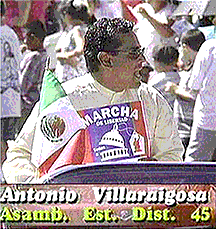 |
| Villaraigosa at the radical |
"The students in this state and the labor movement and those who are probably in this room were the only ones who understood what was at stake with 187," Torres said. "Remember, 187 is the last gasp of white America in California."
Torres said the "last gasp" remark was a reference to the far right in California.
"It's that fringe group that thinks all Latinos are for a Quebec-type Aztlan in California," Torres said.
The article also goes into Villaraigosa's participation in the infamous (see photo on left): Villaraigosa's critics say he was the only elected official from Southern California who spoke at the Latino rally in Washington, even though several others were invited. Organizers of the rally issued seven demands, including amnesty for illegal immigrants and free education for all through college.
The Union-Tribune article also mentions Villaraigosa's shameful performance at the Southwestern Voter Registration and Education Project meeting:
Villaraigosa sharply criticized unnamed
Latino leaders for supporting legislation that denies driver's
licenses to illegal immigrants. "They don't belong in office,
friends," Villaraigosa said. "They don't belong here."
 Listen to Villaraigosa make
this remark.
Listen to Villaraigosa make
this remark.
Assemblyman Steve Baldwin, a conservative Republican from El Cajon, said he likes Villaraigosa personally but wishes that he would clearly disassociate himself from Latino separatist groups, according to Mendel's article. The article also says that what Villaraigosa wants is not to cut himself off from groups, but to reach out. He said he respects the views of those who disagree with him, even Coe, and thinks that he was elected to work with all people and solve problems.
It is no wonder this article can no longer be found on the Union-Tribune website.