When Hermandad is Not Brotherly
Crime/Corruption News
Keywords: CORRUPTION, ETHNIC POLITICS
Source: Heterodoxy
Published: October 1999
Author: K.L. Billingsley
| This item was found on The Free Republic, a public forum. Click on the link above to read the commentary or to participate in the discussion. |
"We are going to get you, pinche cabron," said the voice on the phone, in the threatening manner of some ripped off customer who was after the punk who had failed to pay off on a drug deal or gambling debt. But the recipient of the call was no small-time hood. He was Robert Cervantes, a former California assistant superintendent of education, with a Ph.D. in educational psychology. And he hadn't ripped off anyone. Quite the opposite, in fact. In the course of his duties as overseer of adult education programs, Cervantes had discovered that a group of so-called Community-Based Organizations (CBOs) could not account for how they had spent millions in federal funds. Some of these funds, slated for English classes, had gone toward such educational items as jewelry and Mercedes-Benz automobiles., Those on the receiving end of the millions did not appreciate the publicity, and Cervantes was soon to learn that those threatening him were not just puffing wind.
Colleagues tipped him off that a former National Guardsman was being paid to find out where Cervantes lived. Gang types began hanging around his residence, and the houses on either side of Cervantes burned to the ground, with arson the probable cause. A graying, softspoken man who could pass for a high school guidance counselor, Cervantes began to be very "security conscious." But these were only part of his woes. His revelations ultimately got him fired, a political decision yet to be reversed, even though he has been vindicated.
In July, California's state auditor, Kurt Sjoberg, confirmed everything Cervantes had said in a report that got little ink from a sleepy capital press corps and brought no comment from either Democratic governor Gray Davis or State Superintendent of Education Delaine Eastin. Both Eastin and Davis had good reason to keep the issue quiet, because what the state's press corps had missed was a story that revealed the dynamics of the ethnic politics increasingly dominating the state and tapped a vein of California history barred from discussion under the current regime of political correctness. The back story, and its key player, a man named Bert Corona, stretched all the way to the 1930s, to the heyday of the popular front. It confirmed that Democratic Party funding of the left is not history but news. And it was a case study of how a career path on the farthest reaches of the left can expect abundant rewards within the system. The revelations of the July audit came larded in bureaucratic boilerplate that failed to identify the groups in question, even though they were matters of public record and, in some cases, the subject of ongoing FBI investigations. The ten CBOs involved are a kind of interlocking
 |
|
|
CBO number one is the Mexican National Brotherhood, a nationwide organization usually referred to by its Spanish name, Hermandad Mexicana Nacional. The Immigration and Naturalization Service once allowed Hermandad to conduct citizenship interviews but stopped the practice when misconduct came to light. The group was the key player in a 1996 voter-fraud scandal surrounding the narrow defeat of Republican Robert Dornan by Loretta Sanchez. Hermandad registered 721 people who were not American citizens, and 442 of them voted illegally.
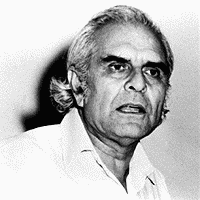
The executive director of Hermandad, at the center of the CBO storm, is Bert Corona, occasionally referred to as Humberto Corona, hailed as a Latino leader, a colleague of Cesar Chavez, an advocate for immigrants, and a friend of Bill Clinton who keeps a residence in Washington.
Corona was born in El Paso, Texas, in 1919, and recalls that the high school there was integrated, including its sports teams. "I don't recall any racial tensions that accompanied playing at El Paso High," Corona told his biographer Mario Garcia. Still, some teachers "held racist versions of the Alamo." Though born in the United States, Corona did not think of himself as an American or even a Mexican-American. "We as Mexicans also had a historic and rightful claim to El Paso and the Southwest," he has said.
Corona recounts with delight stories he was told as a child of Pancho Villa's raiding party into New Mexico in 1916, recalling "how yellow the Americans had been, of how they had begged for their lives, how they had shit and pissed in their pants, crying 'No me mates, no me mates, yo soy amigo de los mejicanos."'
In the mid-1930s, Corona came to the University of Southern California on a basketball scholarship. Although he dropped out of USC, he learned to drive to his left. "Socialism could solve many of the problems created by capitalism," Corona told his biographer. "The Communist Party always stressed the example of the Soviet Union and of the significant progress there since the Bolshevik Revolution." After leaving college, Corona worked with Harry Bridges, longshore boss and secret Communist, as the Venona intercepts of Soviet intelligence traffic confirm. Corona is unapologetic about his Party affiliations: "It is important to understand that a strong relationship existed between Mexican-American activists and the Communist Party in the 1930s." Further, "the Communist Party contained many dedicated people ... not solely interested in promoting the party but committed to advancing the cause of working and poor people." As an organization, he says, the CP played "a positive role in trying to build a democratic trade union movement that would be controlled by the rank and file."
Corona's beat was the Congress of Industrial Organizations (CIO), then solidly Communist in leadership. "The CIO developed a very important relationship with the growing number of Mexican youth gangs in the barrios," notes Corona. "While some delinquency and crimes were associated with gangs, many gangs served as mini-communities for youth." Corona would later cultivate similar relationships of his own.
By all evidence, Corona stayed the course during the Nazi-Soviet Pact, when the Party picketed the White House, called Roosevelt a warmonger, and Party-backed CIO unions struck American defense plants such as North American Aviation in Inglewood, California. Roosevelt called in the troops. Max Silver, a longtime Party boss in Los Angeles, identified Corona as a CP member before World War II, when Party members were given a leave of absence to be patriotic. Corona served on the board of directors of the Los Angeles Communist School with Party stalwarts LaRue McCormick, Eva Shafran, and Leo Gallagher.
After the war, the mass revolutionary upheaval many Communists had been expecting failed to materialize in America, but Corona continued organizing along the lines pioneered by Saul Alinsky. The strategy was based on the community service organization as a kind of front group, like the ones the Communist Party developed during the 1930s and '40s. Corona helpfully notes that ANMA, the Asociacion Nacional Mexico-Americana, was involved with both the longshoremen and the Mine, Mill and Smelter Workers, a CP-led group that backed the making of Salt of the Earth.
Khrushchev's revelations about Stalin made things difficult for CP organizers during the 1950s, when the CIO joined with the anti-Communist American Federation of Labor. But the following decade turned things around for Corona, who kept the faith through hard times.
He busied himself running the Mexican American Political Association (MAPA), the successor to ANMA. In 1965, California Governor Edmund "Pat" Brown, Jerry's father, appointed Corona to the California Civil Rights Commission. Corona's Stalinism was to provide public-relations problems for Cesar Chavez, with whom he marched.
During the '60s, Corona threw MAPAs support to the Brown Berets, a Chicano militia styled after the Black Panthers, with its own "minister of information" and education, and which had begun in Los Angeles as "Young Citizens for Community Action. Corona organized the National Chicano Moratorium, to oppose U.S. involvement in Vietnam.
In 1968, Corona gave a nationally televised address to the Democratic National Convention in Chicago, urging the seating of the "Texas irregulars," a group that included Chicano militants. The following year Corona founded Hermandad Mexicana Nacional to work for the interests of immigrants, a new vanguard he exploited for other causes, bragging that "we also organized them in protest against the war" in Vietnam.
During the 1970s Corona broke with the Democrats and worked with the separatist La Raza Unida party based on the irredentist concept of a paradise lost called Aztlan, the occupied Chicano nation in the southwest that needs to be wrested from Anglos "by any means necessary."
Though he lacked a college degree, he secured a job as a part-time professor in the Chicano Studies Department at California State University-Los Angeles, where he taught for more than a decade, survived an attempt to fire him for liberal grading policies, and got many of his fellow activists hired. Described in a May 24, 1982, Los Angeles Times story as "an energetic man with a booming voice and a Marxist-Leninist viewpoint," Corona told Robert Cantu, a legitimate scholar about to gain tenure, to get out of the department because his retention in a tenured post would mean fewer part-time hires.
Cantu recalls that Corona surrounded himself with a "bunch of thugs," one of whom threatened the professor. Cantu held his ground but five days after he got tenure his car exploded into flames.
"What happened to your car is nothing," Cantu says Corona later told him. "We can get rid of you by getting the community against you. You may have tenure but you are not going to have peace."
|
Hogwash Department Hermandad Mexicana Nacional The Hermandad Mexicana Nacional is the nation's largest Latino immigrant's organization, with over 30,000 member families across the country. Founded in San Diego, California in 1951, it is a not-for-profit mutual-aid organization that combines the strong family values of Latin American culture and the deeply-rooted United States tradition of volunteerism. The Hermandad welcomes members from all the Spanish-speaking countries of the Western Hemisphere. As an expression of this broad membership, the New York Chapter is called the Hermandad Hispana Nacional.
|
Corona also opposed Professor Hector Soto-Perez, who found his tires slashed and brake cable cut. Corona blamed the attacks on the police, but after he left campus, the violence stopped. Corona went on to teaching stints at Cal State Northridge, UC Berkeley, Stanford, Yale, and Harvard. His message involved support for the increasingly unstable communist regimes of Eastern Europe. "Renewed class struggle in these societies will lead to new forms of social arrangements," he said. "The workers of East Germany, for example, aren't about to give up easily many of the supports they had under socialism, such as low rents and free education for their children."
In 1996, the Southern California Library for Social Studies and Research, a legacy of the CP heyday in Southern California, honored Corona and his Hermandad troops. The sponsoring committee comprised an honor roll of the left wing of the Democratic Party, including Assemblyman Gil Cedillo; Antonio Villaraigosa, now California Assembly Speaker and aspiring mayor of Los Angeles; Tom Hayden, the New Left oracle and state senator; Dobie Gillis alum Sheila Keuhl, now head of the California assembly's lesbian-left caucus; along with filmmaker John Sayles, Marxist professor Rudy Acuna, actor Ed Asner, and emeritus Communists Dorothy Healey, Paul Jarrico, and John Randolph. By the time of that gala event, Hermandad, under Corona's helmsmanship, had become a kind of domestic Third World dictatorship, in style, tactics, and fiscal policy.
Corona had prevailed on the Los Angeles Times to stop using the phrase "illegal alien," which gave way to "undocumented." When the Los Angeles Times wrote about Hermandad registering non-citizens to vote, the group rushed a mob of 300 protesters to the paper's offices in Costa Mesa, demanding a boycott of the publication. It didn't work and, for all his leverage, Corona was unable to block the Times reporting on Hermandad's financial woes.
By 1997, despite receiving a staggering $35 million in grants during the previous decade, Corona's Hermandad was $8 million in debt, including $4.2 million on its new Los Angeles health clinic. In 1995, Hermandad was evicted from its North Hollywood office and sued for $400,000 in back rent. Rank-and-file employees complained they had not been paid, but the lifestyle of Bert Corona did not suffer. Neither did that of Orange County Hermandad boss Nativo Lopez, a Corona crony.
"The whole Hermandad organization is a money-making situation for him," said Al Chavez, a member of the Democratic Central Committee in Orange County. "He's very much building a political machine, and for some reason, very few people are willing to speak up about it." And there was lots to speak up about.
Hermandad used its employees' withholding taxes to pay bills, a violation of state and federal law. The U.S. Department of Health and Human Services demanded the return of a grant for $404,248 but no charges were filed. Corona's years of experience had tapped into multiple pipelines, and the group proved equally creative with federal funds received though California's Department of Education. CDE officials had long been aware of improprieties with Hermandad, but the group deployed strategic point-men within the department, tasked with keeping the money flowing.
Hermandad requested funding for a stupendous 22.4 million student hours, including one million in the same county as CBO 6, The TODEC Legal Center of Perris, its Siamese twin. The CDE approved all but 760,000 hours. CBO 6 produced records, obvious fabrications, showing every student attending every weekday from August 1997 to April 1998, including Labor Day, Christmas, New Year's, and Thanksgiving. One student was shown attending 3,406 hours in five classes, a Stakhanovite schedule that would have required a nine-hour class day. These were cons a high school student could have conceived and which an Inspector Clouseau on downers would have spotted in an instant. And besides overlap among the groups, there is obvious duplication.
The services Hermandad, One-Stop Immigration and Education Center (CBO number two in the report), and others offer are widely available at other sources such as public schools, often free or at low rates. The entire flow of money was unnecessary, except as a gift to Corona.
Through the CDE, Hermandad received 23 grants, from $428,000 in 1994-95 to $3,500,000 in 1997-98, the largest funding to any CBO during those years. The department continued the funding even though Robert Cervantes noted concerns and Hermandad provided no documentation.
"There were no controls," says Cervantes. "It was the worst I had ever seen." The volcanic, white-maned Corona, lawyer and personal goon squad in tow, threatened Cervantes, accusing him of being a traitor to his people. Corona told Cervantes he did not want anyone snooping around his books and that he intended to put a stop to it.
State Education Superintendent Delaine Eastin, a former Bay Area Democratic assemblywoman, is the candidate of choice for the California Teachers Association, a Democratic Party stronghold. Eastin styles herself a tough advocate of accountability, but during the height of the misconduct her Department of Education gave all the CBOs a clean bill of health and took until June of 1998 to demand repayment of $4.3 million from Hermandad.
Corona took up the issue with Richard Polanco, telling the Democratic state senator from Los Angeles that Cervantes needed to be stopped. He was. Delaine Eastin had Cervantes fired, claiming, in classic bureaucratic style, that it had nothing to do with his work exposing the corrupt CBOs. Likewise, the state controller's office, under Democrat Kathleen Connell, reprimanded Alan Cates, who worked with Cervantes to uncover the fraud and is now with the FBI.
Though his organization was bankrupt, Corona found money to bus protesters to Sacramento, and won back most of a $2.1 million grant that had been denied in February of 1997. And despite the problems, the Department of Education awarded grants to Hermandad including another $3.5 million in October of 1997. For that year, Hermandad's request for 2.5 million student hours for citizenship classes was almost seven times the hours it reported in the previous year. None of the $4.4 million has been recovered and Corona, with full impunity, has openly defied the order to repay.
Some of the smaller organizations admitted misconduct and attempted to give some money back, but the California Department of Education refused to accept it. They took this as a license to spend it as they chose, and in one case, a woman used the federal funds to purchase a Mack 18-wheeler for her husband's trucking business. The total amount in the scandal, some auditors estimate, exceeds $50 million.
The Department of Education's response to the July 1999 audit, a true collector's item, said CBOs are "passionate about the work they do for their community," and "well intentioned about keeping accurate records." The CDE is not funding Hermandad for 2000 but the group should not be counted out. Bert Corona is a political Elfego Baca, with more than nine lives, and still livin' la vida militant after all these years. He knows the Republicans are out of power and fail to understand political combat even when in power. Better still, he knows that the Democratic Party establishment prefers not to know what its far-left hand is doing. Already, Corona's allies in the legislature are taking steps to keep the money flowing.
Assembly Bill 33, introduced by Nell Soto, and co-authored by, among others, Gil Cedillo and Tom Hayden, contains the "Tom Hayden Community-Based Parent Involvement Grant," which apportions money for "training courses for parents," with funds "directed to non-profit community-based organizations through a grant program administered by the State Department of Education" and conveniently channeled through school districts. State officials remain reluctant to place the CBO case where it belongs, with Attorney General Bill Lockyer, a liberal Democrat who claims to detest white-collar crime.
A small business owner who admitted in print that he used employee withholding to pay bills could expect to serve time, pay a heavy fine, or both. Likewise, the IRS does not accept "good intentions" as a defense in tax-fraud charges. Had the CBOs been linked to white separatists or the "religious right," groups that are also passionate about their work, the groups would have been shut down long ago and the ringleaders jailed. But no charges have yet been filed or arrests made, leaving Cervantes and other auditors baffled.
Despite an abundance of damning evidence, the investigations have dragged on for years. A member of a federal agency now looking into Hermandad downplays the fraud as a petty and typical matter, describes Corona as a "nice guy" and a hero to his people, a man who walked shoulder to shoulder with Cesar Chavez. The impression, clearly given, was that such a person, whatever they might have done in this case, couldn't possibly be charged with a crime, and that lack of funding in future might be sufficient punishment. If a case of this magnitude, with a clear paper trail, fails to produce charges or convictions, that will give the game away.
But the game is not over for Robert Cervantes, who has no regrets, stands by his work, and is going after the Department of Education in court over his firing. But he is now aware that being an auditor is a dangerous job, part of the violence inherent in the system. "'We're going to get you, pinche cabron,"' he repeats what his anonymous caller said. They are still trying. In late August, assailants deliberately sideswiped a car in front of his house.
Cervantes has learned that trying to do your job in an era of ethnic politics is truly quixotic.

